
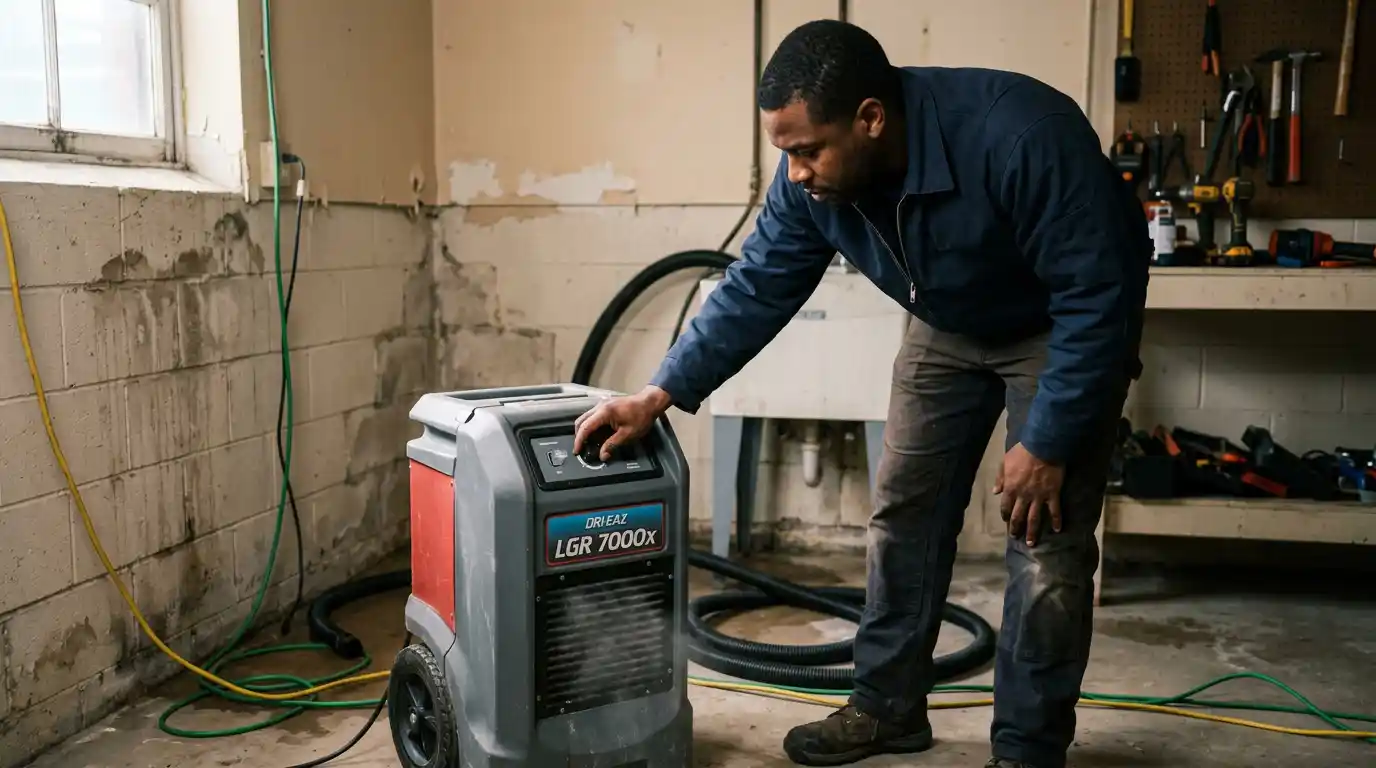
In four-season properties, water damage is rarely just a puddle on the floor. Winter pipe breaks, roof and ceiling leaks, appliance failures, spring runoff, and storm-driven intrusion can leave moisture inside drywall, subfloors, insulation, and framing long after visible water is gone.
In these conditions, dehumidification is not a side step. It is a core part of drying, damage control, and better restoration decisions.
What a dehumidifier actually does after water damage
A dehumidifier supports drying by pulling excess moisture out of the air so wet materials can release trapped water more effectively.
After the extraction removes standing water, the bigger problem is often the moisture you cannot see. Wet framing, carpet pad, subfloors, and wall cavities keep releasing water vapor into indoor air. If that humidity stays elevated, materials dry slowly or unevenly. A dehumidifier lowers the moisture load in the air so water can keep moving out of materials instead of lingering inside them.
That is why drying and dehumidification are typically paired in restoration work, not treated as separate issues.
It is not the same as water extraction
Extraction removes bulk water. Dehumidification helps address the moisture that remains after extraction, especially in porous and semi-porous materials. A property can look dry on the surface while still holding enough residual moisture to support odors, swelling, staining, or later microbial growth. Our water-damage guidance treats drying and dehumidification as a distinct step after removal of standing water.
It helps indoor humidity return to a more normal range
Flood and leak events often push indoor humidity far above normal living conditions. That matters because damp air slows evaporation and can keep materials wet longer. Drying and dehumidification are part of restoring normal humidity levels after a loss.
Why this step matters in four-season properties
Seasonal moisture patterns make hidden dampness more stubborn than many owners expect.
In higher-exposure homes, lake communities, river corridors, mixed-use corridors, and outlying properties, moisture problems often do not start and stop on the same day. Freeze-related leaks can soak concealed areas during colder months. Runoff and wet basements can keep lower levels damp in spring. Wind-driven rain can reopen vulnerable areas around roofs, siding, or windows. That makes dehumidification especially important because it helps manage the lingering humidity load after the initial source is addressed.
Burst pipes and appliance failures often leave hidden moisture
Water from a pipe break or failed appliance does not always stay in one visible area. It can run under flooring, behind baseboards, through insulation, or into lower levels. We offer burst pipe repair, appliance failure services, basement water extraction, and water damage restoration, which provides strong drying and humidity control.
Flooding and wet basements are not just extraction problems
When water enters a basement or lower level, dehumidification helps reduce the moisture left behind in concrete, framing, and contents after pumping and cleanup. The process includes structural drying, water extraction, mold remediation, and drying and dehumidification are part of the restoration process. For related reading, see flood damage restoration and preventing secondary water damage after cleanup.
What dehumidifiers help prevent
Proper dehumidification reduces the chance that a manageable loss turns into a bigger one.
Mold and mildew risk
Drying should begin within 24 to 48 hours after water damage to help prevent mold growth, and if a flooded home and its contents are not dried within 24 to 48 hours, you should assume mold may be present.
That timing is one reason dehumidification matters so much after extraction. It supports faster drying and reduces the moisture conditions that mold needs to gain ground. Learn more in this guide to mold removal and remediation.
Swelling, staining, and material breakdown
Drywall, trim, wood flooring, insulation, and ceiling materials can continue to degrade when hidden moisture remains. A room that feels “mostly dry” can still have moisture moving through assemblies for days. That is why delayed or incomplete drying often leads to bigger repair scopes later. Our resource on when damage keeps growing speaks directly to this pattern.
Secondary odor and contamination issues
Damp materials can hold onto odor and contamination more stubbornly than dry materials. That matters after gray-water events, sewage backups, and some storm losses, where debris or dirty water enters the structure.
If your property still feels damp after extraction, or you suspect moisture is trapped behind walls, under floors, or in a basement, schedule professional water damage restoration before secondary damage expands.
When a standard household unit may not be enough
Small consumer units can help with mild dampness, but major losses often require a larger drying plan.
Larger losses need controlled drying, not guesswork
A small portable unit may help with minor humidity issues, but it may not keep up with a burst pipe, multi-room leak, wet insulation, or flood event. Drying, structural drying, extraction, and repairs are coordinated steps, which reflect the reality that bigger losses affect both air moisture and building materials at the same time.
Commercial spaces have more disruption risk
In offices, retail spaces, shared buildings, and tenant-occupied properties, drying delays can affect operations, finishes, and scheduling. Faster humidity control can help reduce downtime pressure, support safer cleanup sequencing, and limit the spread of moisture into adjacent spaces. We provide service for both homes and businesses across water, flood, fire, mold, and storm losses.
What you should do while drying is underway
Good decisions on the first day or two can make dehumidification more effective and reduce avoidable damage.
Prioritize safety first
Do not walk through standing water near outlets or appliances, and do not assume a stained ceiling, wet wall, or soaked floor is structurally sound. Shut off electricity where needed, stop the water source if possible, remove belongings, and contact a restoration professional quickly. For a practical companion piece, review these dos and don’ts after water damage.
Reduce delay, not just visible mess
Do not wait for visible puddles to disappear before acting. Hidden moisture is often the reason a small loss becomes a larger reconstruction issue. That is especially true in newly finished spaces or recently remodeled properties where wet materials may be concealed behind clean surfaces. See water damage in new homes for how hidden moisture can expand in newer construction.
The bottom line on dehumidifiers in restoration
Dehumidifiers are central to the drying strategy because they help remove the moisture you cannot mop up or see.
After water damage, the goal is not just to remove water. It is to dry the property thoroughly enough to limit secondary damage, protect materials, and support smarter repair decisions. In four-season properties where burst pipes, runoff, wet basements, appliance failures, and storm-related intrusion all play a role, dehumidification is one of the most important tools in the restoration sequence.
Frequently Asked Questions
1. Why is a dehumidifier needed after standing water is removed?
Removing standing water only solves the visible part of the problem. Moisture often remains in drywall, wood, insulation, flooring, and indoor air. A dehumidifier helps those materials keep releasing trapped moisture so the property can dry more completely and with less risk of secondary damage.
2. Can you skip dehumidification if the room looks dry?
You should not assume a room is dry just because surfaces no longer look wet. Hidden moisture can remain behind walls, under floors, or inside ceilings and continue affecting materials. That is one reason incomplete drying can lead to bigger repair needs later.
3. How quickly should drying begin after water damage?
Drying should begin as soon as possible. The EPA says cleanup and drying should start within 24 to 48 hours to help prevent mold growth, and if flood-damaged contents are not dried in that window, mold should be assumed.
4. Does a dehumidifier help after a burst pipe?
Yes. Burst pipes can send water into wall cavities, flooring systems, and lower levels, not just onto visible surfaces. Dehumidification helps reduce the moisture left behind after extraction and supports more complete drying of affected materials.
5. Is dehumidification important after basement water intrusion?
Yes, especially in lower levels where concrete, framing, stored contents, and finishes can stay damp after pumping.
6. Can a household dehumidifier handle major water damage?
A household unit may help with mild dampness, but it may not be enough for a multi-room leak, flood event, or saturated building materials. Larger losses usually need extraction, controlled drying, and repair decisions working together rather than a single small unit running in one room.
7. Does dehumidification help reduce mold risk?
It helps by lowering the moisture conditions that mold needs to grow. It is not a guarantee by itself, and it does not replace source control, removal of unsalvageable materials, or proper cleaning. But it is one of the most important parts of preventing moisture from lingering too long.
8. What kinds of water-damage situations make dehumidifiers especially important?
They are especially important after flooding, wet basements, appliance failures, ceiling leaks, burst pipes, and storm intrusion. These losses can leave hidden moisture behind after the initial event.
9. Does dehumidification matter in commercial buildings too?
Yes. In commercial properties, excess humidity can affect multiple rooms, finishes, contents, and occupancy schedules. Faster moisture control can help support cleaner repair sequencing and reduce disruption for tenants, staff, and day-to-day operations.
10. What should you avoid doing while drying is underway?
Do not ignore electrical hazards, do not assume stained ceilings or soaked finishes are stable, and do not delay action because water is no longer visible. Our experts recommend focusing on safety, stopping the source when possible, moving belongings, and contacting a qualified restoration professional promptly.
11. Can dehumidification help after sewage or contaminated water events?
It can help as part of the drying process, but contaminated losses involve more than moisture control alone. Sewage backup cleanup, cleaning, sanitizing, removal of contaminated water, and material decisions may all be necessary depending on what was affected.
12. Why do four-season properties need extra attention to drying?
Because seasonal patterns can layer moisture risks on top of each other. Freeze-related leaks, runoff, wet basements, and storm exposure can all create situations where drying is delayed or incomplete, especially in concealed spaces. That makes good dehumidification more important, not less.