
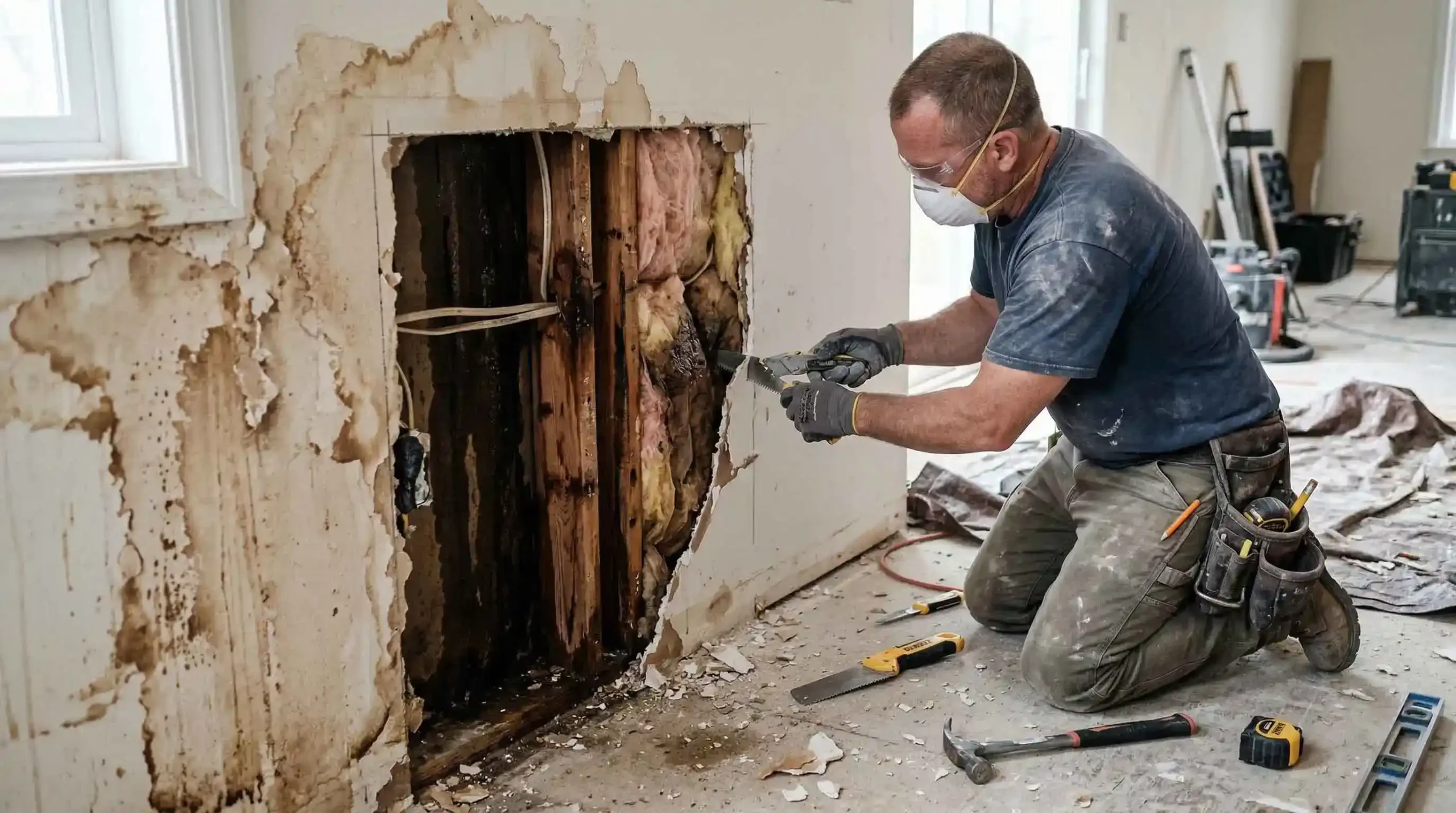
Across four-season neighborhoods, drywall problems rarely start as dramatic failures. A winter pipe freeze can wet an exterior wall cavity. Spring runoff can leave a lower level damp for days. Shoulder-season storms can push water in around roofing or siding details. In commercial corridors and seasonal visitor districts, even a small leak can interrupt occupancy, delay turnover, and create a bigger repair if moisture stays trapped behind paint, trim, or insulation.
The good news is that water-damaged drywall is not always a tear-out. The wrong move, however, is treating every stain as cosmetic. Drywall can sometimes be dried and repaired, but only when the moisture event is limited, the material is still structurally sound, and drying starts quickly enough to prevent secondary damage. The EPA says water-damaged materials should be dried within 24 to 48 hours to help prevent mold growth.
If you are dealing with active moisture, bubbling paint, or a ceiling that looks soft or swollen, Insight Restoration offers water damage restoration with IICRC-certified technicians, 24/7 response, and thorough documentation for insurance purposes. Call now (208) 946-9648.
The short answer: sometimes yes, often no
Drywall can usually be saved when the water exposure was brief, the source was relatively clean, and the board has fully dried without losing strength. In practical terms, that means the panel is still firm, the paper facing is intact, there is no sagging, and the damage is limited to minor staining or a small area around a leak that was stopped quickly.
Replacement is usually the safer choice when drywall is soft, swollen, crumbling, sagging, delaminating, or still reading wet after drying efforts. It also leans toward replacement when moisture moved into insulation, framing edges, baseboards, or ceiling cavities, because what looks like a surface stain can hide a bigger drying problem behind the wall.
Five questions that decide whether drywall can be saved
1. What was the water source?
A clean supply-line leak is very different from overflow, runoff, or water that may contain contaminants. The more questionable the water source, the less sense it makes to gamble on porous materials. Drywall is not just a finished surface. It can absorb moisture into the paper and gypsum core, and that raises the risk of odor retention, finish failure, and hidden deterioration.
2. How long was it wet?
Time matters as much as volume. A wall that got damp and was dried right away may survive with minor repair. A wall that stayed wet for a day or two, especially in a closed room or lower level, moves into riskier territory. The EPA’s guidance to dry water-damaged materials within 24 to 48 hours is useful because the longer moisture lingers, the more likely you are to see microbial growth, staining that returns through paint, and damage to adjacent materials.
3. Has the drywall lost its shape or strength?
Press gently near the damaged area. Does it feel soft, spongy, or brittle? Is the paper wrinkled, peeling, or separating from the core? On ceilings, any sagging or bowing deserves extra caution. Drywall that has lost its rigidity may look repairable after it dries, but it often continues to fail later through cracking, nail pops, seam movement, and texture or paint breakdown.
4. Is there likely hidden moisture?
This is where many bad decisions happen. A wall can look dry while the back side, insulation, or bottom plate stays wet. That is especially common in older hillside homes, lake-adjacent properties, and areas with repeated wetting. Hidden moisture is what drives re-wetting, musty odor complaints, corrosion at fasteners, and recurring finish defects months later.
5. Are there signs of secondary damage?
Watch for staining that keeps spreading, bubbling paint, tape lifting, musty odor, warped trim, soft baseboards, or recurring dampness after weather changes. Those clues often point to a problem that is bigger than a simple patch.
When drywall is usually worth saving
Drywall is most often salvageable when all of the following are true:
- the leak was caught early
- the wet area is limited
- the panel remains firm and flat
- the cavity was dried completely
- no visible mold or persistent odor is present
- the finish can be restored without trapping moisture behind primer or paint
In those cases, the path may be drying, moisture verification, minor patching, stain-blocking primer where appropriate, and repainting.
When replacement is the better decision
Replacement is usually the better call when drywall has been saturated, stayed wet too long, contains obvious deterioration, or sits below a leak line where moisture is likely pooled inside the wall. It is also the cleaner decision when a property owner is trying to avoid repeated disruption. One controlled cut and proper rebuild can be less expensive than repainting over a wall that later smells, stains, or fails again.
This is also where mold risk becomes part of the decision. Insight’s own guidance notes that mold can begin growing within 24 to 48 hours after water exposure, and the company’s mold process includes inspection, containment, air filtration, and removal steps designed to address moisture-related growth at the source. If that possibility is on the table, mold removal and remediation should be part of the conversation rather than an afterthought.
A practical decision framework for homes and commercial spaces
For homeowners, the main question is often whether a repair will hold through the next season. For business owners and property managers, it is usually about occupancy, finish durability, and avoiding repeat work between tenants, guests, or employees.
A sound decision usually follows this order:
Stop the source
Do not patch before the leak, overflow, seepage path, or humidity problem is addressed.
Protect the area
Use general caution around wet materials, outlets, and fixtures. If water may be contaminated or ceilings are sagging, treat it as a professional assessment situation.
Dry first, then evaluate
Drying is not a cosmetic step. It is the test that tells you whether the assembly can be kept.
Open what cannot be confirmed
If moisture may be trapped behind the wall or above the ceiling, limited removal is often more honest than wishful patching.
Rebuild only after conditions are stable
Painting over a marginally dry wall is how stains come back, tape peels, and odors linger.
What not to do
Do not assume a dry surface means a dry wall cavity.
Do not paint over staining before the moisture issue is resolved.
Do not ignore odor just because the wall looks better.
Do not leave wet insulation in place and expect drywall to stay sound.
Do not rely on appearance alone when ceilings or lower wall sections were soaked.
The takeaway
If the drywall is only lightly affected and verified dry, repair may be enough. If it is soft, swollen, contaminated, repeatedly wet, or hiding moisture in the assembly, replacement is usually the more durable decision. The goal is not just to make the wall look normal again. It is to prevent re-wetting, odor absorption, hidden mold risk, corrosion, and finish failures that turn a smaller incident into a larger restoration project.
When the decision is not obvious, Insight Restoration combines over 50 years of experience, IICRC-certified technicians, 24/7 emergency restoration services, and thorough documentation for insurance purposes to help property owners move from mitigation into repair with less guesswork. Call now (208) 946-9648.
Frequently Asked Questions
1. Can drywall dry out after a leak and still be okay?
Yes, sometimes. Drywall can remain serviceable when the leak was brief, the material stayed structurally sound, and the wall assembly was dried fully before secondary damage developed. If the board is still firm and flat and there is no odor, sagging, or visible growth, repair may be possible.
2. Does stained drywall always need to be replaced?
Not always. A stain can be the leftover mark from a limited event, but it can also be a warning that moisture is still active or that the finish has already been compromised. The right question is not whether the stain looks small. It is whether the wall is truly dry and stable.
3. How can I tell if drywall is too damaged to save?
Look for softness, swelling, crumbling edges, bubbling paint, seam movement, peeling paper, sagging ceilings, or persistent odor. Those signs suggest the material may have lost integrity or that moisture remains in the wall cavity. In those situations, replacement is often the more durable route.
4. Is ceiling drywall different from wall drywall after water damage?
Ceiling damage deserves more caution because wet drywall overhead can sag or lose strength faster. Even when the stained area looks limited, pooled moisture above the ceiling can spread farther than expected. A ceiling that bows, feels soft, or shows seam movement should be assessed carefully before anyone works below it.
5. What if the water came from an overflow or outside intrusion?
That usually raises the stakes. Once the water source becomes less predictable, porous materials are harder to trust because they can retain contaminants, odor, and moisture in the core. Replacement becomes more likely when the source was not a simple clean-water leak.
6. How fast does mold become a concern behind drywall?
Quickly enough that early drying matters. The EPA advises drying water-damaged materials within 24 to 48 hours to help prevent mold growth, and CDC guidance similarly warns that if flooded materials were not dried in that window, mold should be assumed. That is why delayed decisions often become more expensive.
7. Can I just repaint over a water-damaged area if it looks dry?
That is risky if the wall has not been properly evaluated. Paint can hide staining for a while, but it does not fix trapped moisture, hidden growth, weakened drywall paper, or ongoing leakage. If the assembly is not dry and stable first, the finish often fails again.
8. Should lower drywall be cut out after a wet floor or seepage event?
Sometimes, yes. Lower wall sections are common collection points for moisture, especially when water moved under baseboards or into insulation. Limited removal can be the better choice when drying cannot be confirmed or when repeated wetting makes hidden damage more likely.
9. Can odor mean the drywall should be replaced?
It can. Persistent musty odor often signals retained moisture, hidden growth, or wet materials nearby that were not dried completely. Odor alone is not a complete diagnosis, but it is a strong reason not to treat the problem as cosmetic.
10. Does insurance usually cover wet drywall?
Coverage depends on the policy and the cause of loss. Insight’s water damage page notes that standard homeowners coverage often varies by cause, and flood damage is typically not covered under a standard policy. Property owners should confirm details directly with their insurer and use documentation to support the claim process.
11. What company facts matter when choosing help for water-damaged drywall?
For this topic, the practical details are whether the team handles drying, repair, and related moisture issues, whether technicians are IICRC-certified, whether emergency service is available, and whether documentation is provided for insurance purposes. Those points are all stated on Insight’s water damage service page.
12. If drywall has to be removed, what happens next?
After the affected material is removed, the focus shifts to drying the cavity, confirming stable conditions, addressing any mold concerns, and rebuilding with proper repairs and finishes. Insight’s construction and repair page states that the company handles drywall replacement as part of broader repair and reconstruction work.